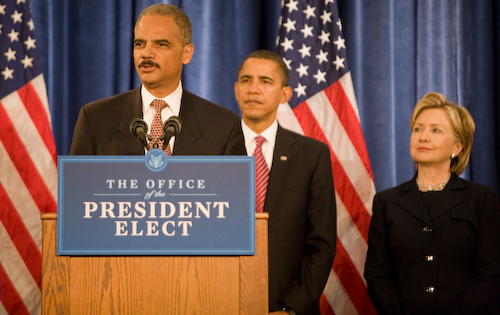
On April 9, 2014, Attorney General Eric H. Holder, Jr. spoke
at the Annual Convention for the National Action Network (NAN), a civil rights
organization founded by Reverend Al Sharpton. Holder began by honoring Dr. Martin Luther
King, Jr., who was killed on April 4, 1968, almost exactly forty six years from the
date of the convention. Holder acknowledged that Dr. King dedicated
his life to building a more just society and left us with a charge to “confront
the challenges of our time.” Holder
praised NAN for their work, and for advancing “the cause of justice that has
always been at the center of [the Obama] Administration’s work.” Thus, Holder seemingly proposed “justice” as
the foundation of Obama’s criminal policy, and compared the goals of the
Administration to those of Dr. King.
Showing posts with label Gideon v. Wainwright. Show all posts
Tuesday, April 29, 2014
Holder Signals Changes Coming to Criminal Law
Tuesday, April 15, 2014
Indigent Defendants and the Role of Their Public Defenders
On March 18,
1963, the Supreme Court held in Gideon v. Wainwright that states are responsible for representing defendants who are
unable to afford their own attorneys. Justice Hugo Black gave the Court’s opinion
and stated, "in our adversary system of
criminal justice, any person hauled into court, who is too poor to hire a
lawyer, cannot be assured a fair trial unless counsel is provided for him. This seems to us to be an obvious truth." This obligation imposed on states
stems from the Sixth Amendment, which establishes a defendant’s right to
counsel. It also stems from the due
process clause of the Fifth Amendment, which guarantees a defendant’s right to a
fair legal process. Today however, fifty
years after Gideon was decided, the
quality of legal representation afforded to indigent defendants is concerning
in some states.
Friday, November 22, 2013
Ineffective Assistance of Counsel in Capital Cases
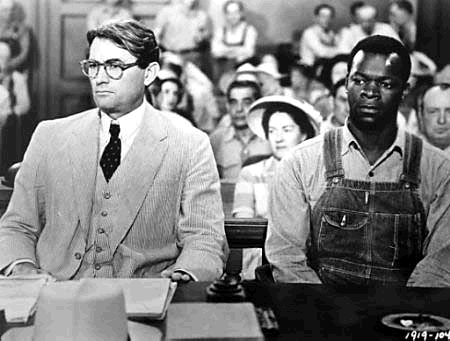
| To Kill a Mockingbird: Atticus Finch and Tom Robinson |
The Sixth Amendment of the United States Constitution grants
criminal defendants the right to counsel in federal cases. In 1963 the Supreme Court extended this right
to state felony prosecutions in the landmark case Gideon v. Wainwright. Twenty-one years after Gideon, the Supreme Court in Strickland v. Washington held that the right to counsel really means the right to effective assistance of counsel. Generally speaking, ineffective assistance of counsel (IAC) can be defined as errors by counsel so severe in nature that the criminal
defendant was denied a fair trial. Strickland
provides a specific test. Under Strickland, a defendant must establish:
(1) their trial lawyer’s performance fell short of an “objective standard of
reasonableness” and (2) “a reasonable probability that, but for counsel’s
unprofessional errors, the result of the proceeding would have been different.”
Subscribe to:
Posts (Atom)