.png)

Showing posts with label Constitution. Show all posts
Showing posts with label Constitution. Show all posts
Friday, March 20, 2015

Tuesday, November 4, 2014
How Real is a Facebook Threat?

The
Supreme Court agreed in June 2014 to hear the case of Elonis
v. United States,
an important First Amendment challenge that will attempt to clarify after years
of ambiguity and split decisions in the lower courts the question of when threats,
specifically internet threats, should be taken seriously by the law.
The case will be heard on December 1st of this year, and will
clarify whether threats of
violence made on social media sites such as Facebook, should be judged by (1) whether the speaker intended to
harm anyone, or (2) whether the recipient was genuinely afraid of being harmed.
Essentially, it is a decision that will decide whether the crime should
be judged by the actor’s subjective intent or the target’s subjective belief.
Online
death threats are becoming all too common.
Recent examples include an 11-year-old who faced death
threats through Facebook
over his love of hunting, a mayor whose life was threatened by his paper boy, and hundreds of Harvard students who received
emails from a
sender who threatened to “shoot all of you” and “kill you individually.”
Tuesday, July 15, 2014
Privileges vs. Rights in a Defendant’s Struggle to “Prove” Innocence
 Evidentiary privileges purport to safeguard interests and relationships. They arise from the rules of evidence and can bar certain pieces of evidence from being used in a trial or other judicial proceedings. The most common and well-known privilege is the attorney-client privilege where an attorney cannot testify to the relationship between him and his client, encouraging an open and honest dialogue with clients and their attorneys. Another example of these privileges is the marital privilege where, in the interest of keeping the marriage tranquil and conflict-free, a husband cannot testify against his wife and vice versa (although the intricacies of how exactly this works varies from jurisdiction to jurisdiction). In general, these privileges can help defendants exclude evidence arising from relationships where society has deemed communications to be private. Understandably, these forms of evidence should be excluded at judicial proceedings, but what happens in a jurisdiction where these privileges exclude evidence that could help, or even exculpate, a defendant? Doesn’t that defendant have the right to a fair trial and due process under the Sixth Amendment? Can privileges created under evidentiary rules really circumvent a defendant’s constitutional rights?
Friday, November 22, 2013
Ineffective Assistance of Counsel in Capital Cases
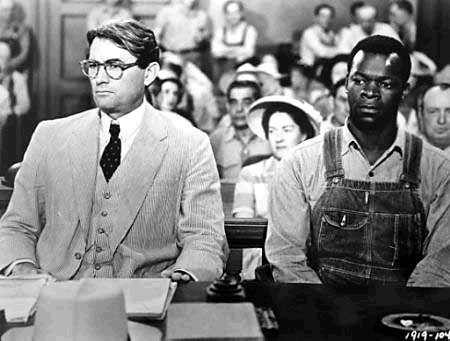 |
| To Kill a Mockingbird: Atticus Finch and Tom Robinson |
The Sixth Amendment of the United States Constitution grants
criminal defendants the right to counsel in federal cases. In 1963 the Supreme Court extended this right
to state felony prosecutions in the landmark case Gideon v. Wainwright. Twenty-one years after Gideon, the Supreme Court in Strickland v. Washington held that the right to counsel really means the right to effective assistance of counsel. Generally speaking, ineffective assistance of counsel (IAC) can be defined as errors by counsel so severe in nature that the criminal
defendant was denied a fair trial. Strickland
provides a specific test. Under Strickland, a defendant must establish:
(1) their trial lawyer’s performance fell short of an “objective standard of
reasonableness” and (2) “a reasonable probability that, but for counsel’s
unprofessional errors, the result of the proceeding would have been different.”
Friday, October 4, 2013
Quality Control in an Era of Confrontation

The
Sixth Amendment of the United States Constitution provides that “[i]n all
criminal prosecutions” the accused shall “be confronted with witnesses against
him.”[1] As with all reserved rights, the question
arises as to what degree and in what context a defendant may exercise this and
other rights. The United States Supreme
Court declared between two cases – Bullcoming
v. New Mexico[2] and Melendez-Diaz v. Massachusetts[3]
– that “testimonial” evidence includes a sworn report submitted by a lab
technician describing the results of laboratory drug tests.[4] Applying this standard excludes a laboratory
report submission under hearsay when a witness is unavailable and the defendant
has not had a prior opportunity to cross-examine. Therefore, a laboratory report prepared in
anticipation for prosecuting a defendant requires the prosecution to produce
the lab technician who performed the tests for cross-examination. A certified report from a laboratory will not
suffice to secure its admission at trial.
Subscribe to:
Posts (Atom)