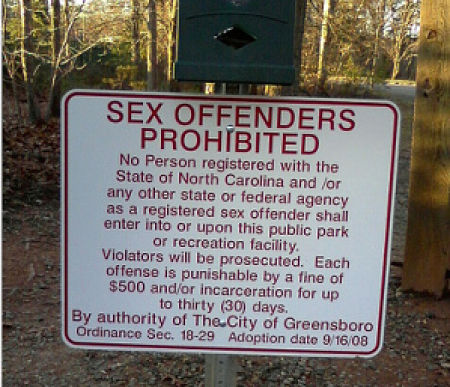
 The sex
offender registry has long been a system relied upon by the government to keep
track of the residence and activities of sex offenders, including ones who have
completed their court-ordered sentences.
It is also a shield designed to protect the public; however, the shield
could soon be weakened when
at least 1,200 names disappear from the State of Maryland’s registry.

Showing posts with label Maryland. Show all posts
Showing posts with label Maryland. Show all posts
Friday, August 29, 2014
Weakening the Shield: Maryland Reforming Sex Offender Registry Laws for the Worse?
The sex
offender registry has long been a system relied upon by the government to keep
track of the residence and activities of sex offenders, including ones who have
completed their court-ordered sentences.
It is also a shield designed to protect the public; however, the shield
could soon be weakened when
at least 1,200 names disappear from the State of Maryland’s registry.
Tuesday, August 26, 2014
Judicial Economy Overstepping? Maryland's Lack of Recognition of Antagonistic Defenses
 It is embedded in our judicial system within the Fifth and Sixth Amendments of the United States Constitution that a person in a criminal proceeding is entitled to have a fair trial with all of his or her due process protections. Stemming from these constitutional provisions, Maryland recognizes in Sessoms v. State the right to “ensure that an accused gets a fair trial free from undue prejudice.” Although Sessoms is speaking directly to other crimes’ evidence, that same fairness is applied throughout the criminal justice system.
Tuesday, July 15, 2014
Privileges vs. Rights in a Defendant’s Struggle to “Prove” Innocence
 Evidentiary privileges purport to safeguard interests and relationships. They arise from the rules of evidence and can bar certain pieces of evidence from being used in a trial or other judicial proceedings. The most common and well-known privilege is the attorney-client privilege where an attorney cannot testify to the relationship between him and his client, encouraging an open and honest dialogue with clients and their attorneys. Another example of these privileges is the marital privilege where, in the interest of keeping the marriage tranquil and conflict-free, a husband cannot testify against his wife and vice versa (although the intricacies of how exactly this works varies from jurisdiction to jurisdiction). In general, these privileges can help defendants exclude evidence arising from relationships where society has deemed communications to be private. Understandably, these forms of evidence should be excluded at judicial proceedings, but what happens in a jurisdiction where these privileges exclude evidence that could help, or even exculpate, a defendant? Doesn’t that defendant have the right to a fair trial and due process under the Sixth Amendment? Can privileges created under evidentiary rules really circumvent a defendant’s constitutional rights?
Friday, April 18, 2014
Courts Apply New Pot Laws to Past Convictions
Until recently,
marijuana has been criminalized in every state, and continues to be illegal at
the federal level today. Colorado’s Amendment 64 and Washington’s Initiative 502 made possession of one ounce of marijuana
legal for persons twenty-one or older. However, both laws failed to comment on
whether these laws would apply retroactively.
A recent Colorado Court of Appeals decision held that Amendment 64 is a
significant change of law allowing, in the interests of justice, retroactive
application.
Tuesday, January 28, 2014
Let’s Get Maryland Marijuana Reform Rolling
 |
State with legal medical cannabis.
State with decriminalized cannabis possession laws.*
State with both medical and decriminalization laws.
State with legalized cannabis.
|
Two recent studies by the ACLU and PewResearch Center suggest that marijuana laws are not being reformed as the public demands. In fact, the studies suggest just the opposite: that marijuana laws are being enforced more than ever before, in a time where legalization is becoming favored by citizens. But what can we, as citizens who frequently feel powerless to change the laws of the State, do to expedite such reform?
Subscribe to:
Posts (Atom)