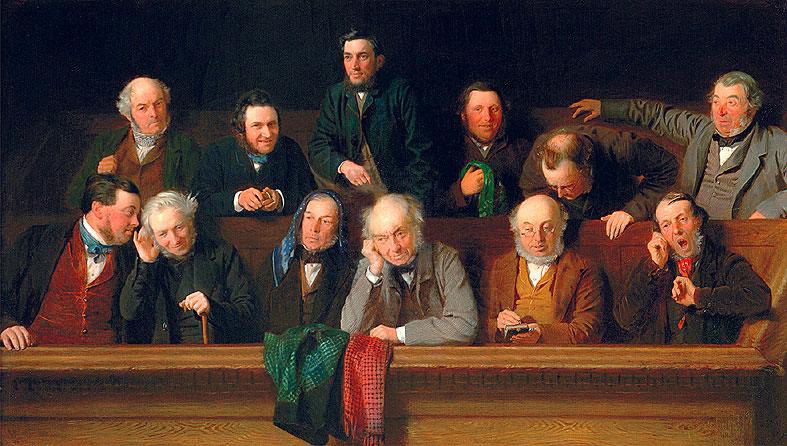
Judicial override
is a concept that has been in place since the late 1970s. It’s a permissive
doctrine that gives state trial judges the option to override a jury’s sentencing
determination and institute a sentence the judge believes is more suitable. In
Alabama, judicial override has been used frequently to override jury verdicts
of life without parole for the death penalty. The Supreme Court will soon
decide whether to grant certiorari on the question of whether Alabama’s use of the
judicial override option violates a defendant’s Sixth Amendment right to a jury as
well as the Eighth Amendment’s prohibitions on
arbitrary and capricious death sentences and cruel and unusual punishment.
Showing posts with label Jury. Show all posts
Friday, April 17, 2015
Tuesday, March 24, 2015
Criminal Trials and PowerPoint: The Importance of Juror Engagement
One huge hurdle that litigators encounter during trials is not
only meeting their burden of proof to prevail, but also keeping the jury
engaged. A jury trial, especially in
more serious or complex matters is not the three minute clip that you see on
television or in the movies. Trials can be long, often
extending over months, depending on the matter
at hand. Throughout that time, we have a
jury box of humans who are taking in all of this information and then tasked
with deliberating to render a verdict. I
specifically point to the jurors as humans, because as humans we have shifting attention
spans. This is why it is extremely
important to put on compelling and engaging presentations to the jury. In the criminal context, it can be very
powerful to display demonstrative evidence in a memorable manner.
Friday, March 6, 2015
Determining Jury Instructions
In
1998 the defendant, Cedrick
Shuler, 36, shot and killed Renee LaShawn Best, 26, in Southeast Washington as
he fired at a man he believed killed one of his friends. The trial court used
two theories of mens rea to instruct the jury on first-degree murder while
armed: first, Mr. Shuler intended to kill Ms. Best, or second, Mr. Shuler’s
intention to kill transferred to Ms. Best under the transferred intent
doctrine.
Tuesday, January 6, 2015
Jones v. United States: Punishment Without Conviction?
Federal sentencing law is widely applied to punish offenders not only for offenses of which they have been convicted, but also, in the same proceedings, for offenses of which they have not been convicted. When convicted of at least one charge, a judge may consider relevant conduct in sentencing the defendant, and even increase the sentence for charges that were never charged. Scholars are split on the subject. On the one hand, some argue the use of relevant conduct at sentencing is often legitimate. Others object to the practice because “the addition of the relevant conduct result[s] in the identical punishment range which the defendant would have encountered had [they] been convicted on all counts.”
Friday, September 20, 2013
Juries: The Community Conscience in America
There
it is. “Breaking News: Verdict reached!”
scrolls along the bottom portion of your television screen or appears as a
notification on your newest smart phone.
We have all seen it. We have all
waited in nervous anticipation for it.
We flick to the nearest news channel, turn up the volume, and crowd
around the screen as the criminal trial enters the final stretch. Those final words are then composedly
uttered, “We the jury find the defendant…”
Tuesday, August 13, 2013
Why Not to Hate Jury Duty
Jury duty. Universally dreaded, with sympathy for a
friend or colleague who has been called, communicated with a knowing roll of
the eyes, and a story about how to get out of it. There is even a wikihow page entitled,
"How to Get Out of Jury Duty." Yet, jury duty is regarded by courts and
civics teachers as one of the most important civic responsibilities a citizen
can perform; it has been a crucial part of our democratic system for over 200 years. The right to a jury trial is a fundamental
right afforded by the Sixth Amendment of the United States Constitution, and
the Due Process Clause of the Fourteenth Amendment. A defendant charged with anything more than a
petty crime, typically a crime with a penalty of more than six months of
incarceration, has a right to trial by jury, made up of between six and twelve
of his or her "peers."[1] Jurors are reflective of the community at
large; there is no education requirement, though jurors must be citizens, over
the age of eighteen, and fluent in English, with few other restrictions.
Wednesday, July 17, 2013
UDC School of Law Professor Andrew Ferguson Weighs in on the Role of Juries and Their Verdicts
On
Saturday, July 13, 2013, the jury in the State of Florida v. George Zimmerman
returned a verdict of not guilty for second-degree murder and manslaughter for
the fatal shooting of Trayvon Martin. After the jury returned the
verdict, an expected flurry of news and social media erupted, some in
support of the verdict and many others criticizing
it. Given the contentious issues surrounding the case, a vast amount
of media attention has honed into the jury and what occurred during the jury's deliberation.
One can hope that the jury deliberation of the Zimmerman trial was similar
to the one that took place in the famous stage play and movie, Twelve
Angry Men, where the jurors carefully examined all the evidence in their quest
for the truth and banished personal prejudices from their
deliberation. On the other hand, many fear that racial biases
may have affected the deliberation of the Zimmerman jury that was made up of
five Caucasian women and one Hispanic woman. Whether the deliberation
was similar to that of Twelve Angry Men or corrupted by racial bias,
many questions remain.
In
his article, "The Zimmerman Trial and the Meaning of Verdicts,"
Professor Andrew Ferguson of the University of the District of
Columbia, discusses the Zimmerman jury, the (at the time
undelivered) verdict, as well as juries and their verdicts in general.
Subscribe to:
Posts (Atom)