On Monday, February 3, 2014, Angela Corey began jury selection as she prepares to prosecute a second, high profile murder case in Florida. Corey is prosecuting Michael David Dunn for the murder and attempted murder of seventeen year old Jordan Davis and his friends. Davis was killed in the parking lot of a Jacksonville, FL gas station on November 23, 2013. Corey is the prosecutor who was hand selected to investigate the Trayvon Martin case in March 2013.
Showing posts with label George Zimmerman. Show all posts
Friday, February 7, 2014
Tuesday, November 19, 2013
Self Defense or Murder?: Is the Shooting of Renisha McBride the Next Big Story?
As the country begins to move past the media frenzy that
followed the killing (or murder, depending on where you stand) of Trayvon
Martin, a new incident has occurred that seems prime to dominate headlines. Around 1:00 am on November 2, 2013, Renisha
McBride drove her vehicle into a parked car in suburban Detroit. Tests would show that McBride had a blood
alcohol content of 0.218%, well above the legal limit in Michigan. A few hours later, a “bloodied and
disoriented” McBride approached the porch of Dearborn Heights resident Theodore
Wafer. Sources report that McBride began
to knock on Wafer’s door, prompting Wafer to come downstairs with his shotgun. Wafer, standing in his home, discharged his
weapon through a closed screen door, striking and killing the twenty-four year
old McBride. Wafer then called 911 to
report the shooting. Wafer told
investigators that he brought down the shotgun because he believed McBride was
attempting to break into his house (though there were no signs of forced entry).
He also claims that the weapon
accidentally discharged while he was investigating the situation. McBride died shortly after and Wafer has been charged with second degree murder.
Friday, September 20, 2013
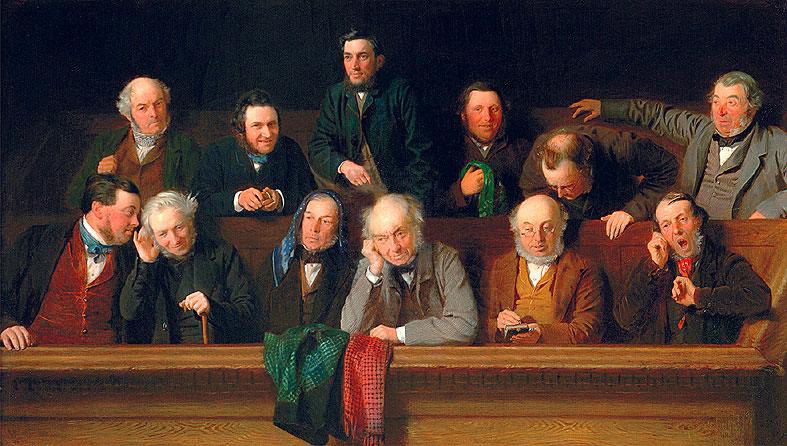
Juries: The Community Conscience in America
There
it is. “Breaking News: Verdict reached!”
scrolls along the bottom portion of your television screen or appears as a
notification on your newest smart phone.
We have all seen it. We have all
waited in nervous anticipation for it.
We flick to the nearest news channel, turn up the volume, and crowd
around the screen as the criminal trial enters the final stretch. Those final words are then composedly
uttered, “We the jury find the defendant…”
Tuesday, August 13, 2013
Why Not to Hate Jury Duty
Jury duty. Universally dreaded, with sympathy for a
friend or colleague who has been called, communicated with a knowing roll of
the eyes, and a story about how to get out of it. There is even a wikihow page entitled,
"How to Get Out of Jury Duty." Yet, jury duty is regarded by courts and
civics teachers as one of the most important civic responsibilities a citizen
can perform; it has been a crucial part of our democratic system for over 200 years. The right to a jury trial is a fundamental
right afforded by the Sixth Amendment of the United States Constitution, and
the Due Process Clause of the Fourteenth Amendment. A defendant charged with anything more than a
petty crime, typically a crime with a penalty of more than six months of
incarceration, has a right to trial by jury, made up of between six and twelve
of his or her "peers."[1] Jurors are reflective of the community at
large; there is no education requirement, though jurors must be citizens, over
the age of eighteen, and fluent in English, with few other restrictions.
Wednesday, July 17, 2013
UDC School of Law Professor Andrew Ferguson Weighs in on the Role of Juries and Their Verdicts
On
Saturday, July 13, 2013, the jury in the State of Florida v. George Zimmerman
returned a verdict of not guilty for second-degree murder and manslaughter for
the fatal shooting of Trayvon Martin. After the jury returned the
verdict, an expected flurry of news and social media erupted, some in
support of the verdict and many others criticizing
it. Given the contentious issues surrounding the case, a vast amount
of media attention has honed into the jury and what occurred during the jury's deliberation.
One can hope that the jury deliberation of the Zimmerman trial was similar
to the one that took place in the famous stage play and movie, Twelve
Angry Men, where the jurors carefully examined all the evidence in their quest
for the truth and banished personal prejudices from their
deliberation. On the other hand, many fear that racial biases
may have affected the deliberation of the Zimmerman jury that was made up of
five Caucasian women and one Hispanic woman. Whether the deliberation
was similar to that of Twelve Angry Men or corrupted by racial bias,
many questions remain.
In
his article, "The Zimmerman Trial and the Meaning of Verdicts,"
Professor Andrew Ferguson of the University of the District of
Columbia, discusses the Zimmerman jury, the (at the time
undelivered) verdict, as well as juries and their verdicts in general.
Subscribe to:
Posts (Atom)